
Union County Previous Residents by Record Era
A Union County address trail does not begin in one master index. Start with the modern parcel and use the evidence that matches the era: the Register of Deeds for a legal transfer, a directory for a historical occupant, a census for a household snapshot, a map for the built setting, and local newspapers or probate for a later family connection. The table uses only coverage that the research verified, including limits that matter when a search moves backward.
| Source | Years It Covers | Where Held | What It Shows |
|---|---|---|---|
| Union online deed index | Deeds from 1973; maps from 1842 | Register of Deeds website and office | Recorded parties, deeds, and plats; mortgages are not available online |
| Union deed books and office index | Earlier county records; exact online cutoff not stated | Register of Deeds, 500 N. Main Street, Monroe | Original recorded instruments and office research access |
| Monroe city directories | 1922-23, 1942-43, 1951-52, 1955-56, 1958-59, 1960-61, 1962-63 | DigitalNC and library resources | Historical address, occupant, spouse notation, phone, and occupation clues |
| Federal census | Through 1950 under the 72-year release rule | NARA, Census, and library databases | Household members, ages, relationships, and geography at enumeration |
| UC Atlas parcel and address viewer | Current dynamic information; aerial layers for 2019, 2021, 2023, and 2025 | Union County GIS | Parcel context, address points, map geometry, and aerial imagery |
| Evolve permits | Public archive; start year not stated | Union County Inspections portal | Permit and inspection dates, address, type, and related project information |
A directory helps answer who may have lived at a place. A deed documents parties to a transaction. Neither alone proves every person who was present at an address, so keep title holders and occupants as separate evidence categories throughout a previous residents search.
The 1922-23 Monroe city directory record on DigitalNC is an early verified directory source for a Union County address trail. It contains names, addresses, civic and business sections, and advertisements.
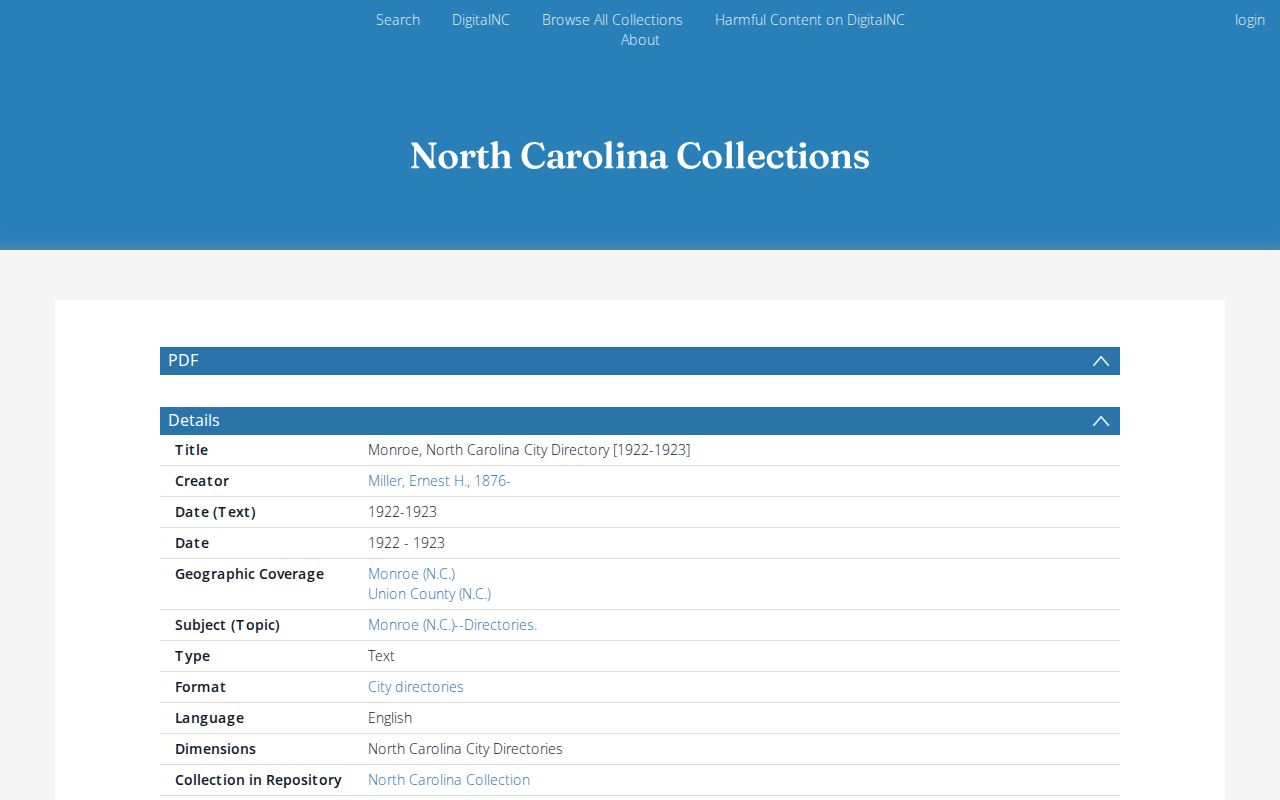
Use the 1922-23 volume as a dated lead, then compare it with later directories, census schedules, maps, or original county records before assigning a continuous history to an address.
Start Union County Previous Residents
For a modern address, Union County directs an address searcher to Tax Administration or UC Atlas, not to the deed system. The Register of Deeds land-record search is name-based. Enter the situs address in the property or GIS tool, then record the parcel or property key, owner name, situs address, separate mailing address if shown, subdivision or lot, and any legal-description clue. That information is the bridge from the present address to the deed index.
UC Atlas offers owner-name, parcel-number, address, and subdivision search modes, plus street search, parcel layers, aerial imagery, and result export. Its mapped boundaries and address points are useful context, but the county says the viewer is map-quality and tax data, not a legal description or survey. Use a recorded deed or plat for controlling land language.
A mailing address can lead elsewhere, but it can also belong to a relative, trust, or other contact. Treat it as an assessment detail rather than proof that an owner lived at the Union County property. This distinction keeps a current parcel card from being mistaken for a complete list of previous residents.
Union County Previous Residents Deed Index
The Register of Deeds says its public website contains deeds from 1973 and maps from 1842, while all office records can be accessed in person. The web scope is deeds and plats only. Mortgage information is not available online, and mechanics liens and judgments belong with the Clerk of Superior Court. The accessible county material did not expose the external live deed-index fields, image rules, or the precise cutoff for earlier books, so a careful search should not assume an address field or a complete online image run.
The office is at 500 N. Main Street, Suite 239 in Monroe. Its land-record guidance says to obtain ownership from Tax Administration before searching the owner's name in the deed index. For earlier material, bring the legal description, lot or subdivision clues, and the names already found. The office fallback is part of the method, not an exception to it.
Deeds in Union County Address History
The deed path works backward by connecting each transfer to the one before it. Confirm the parcel or legal description at every turn because a common name alone is not enough. A previous residents investigation needs that discipline: an owner may not have lived at the place, and an occupant may not appear as a party on a deed.
- Locate the present parcel in Tax Administration or UC Atlas and write down the owner, property key, situs address, subdivision or lot, and legal-description clue.
- Search the current owner as a grantee in the Register of Deeds index and confirm the deed by parcel, subdivision, legal description, recording date, and prior grantor.
- Search that prior grantor as a grantee to locate the acquisition deed that brought the property to that person or party.
- Repeat the grantee-to-grantor step, checking each deed reference and any related plat or lot-block description.
- When the trail reaches the online boundary, continue with the office books and index. Record the source and page or instrument reference for every connection.
- Grantor / grantee
- The grantor transfers an interest in property; the grantee receives that interest. In a backward search, the earlier seller is often the name to search as a grantee for an earlier acquisition.
- Chain of title
- The documented sequence of transfers connecting one owner or party to the preceding one. It is a title trail, not a list of every resident.
- Legal description
- The recorded parcel language, subdivision, lot, block, or metes-and-bounds reference used to identify land. It is more stable than relying on an address alone when comparing old records.
1908 Map for Union County Addresses
The Library of Congress verifies a May 1908 Monroe Sanborn map of four sheets. It is a strong early built-environment check for a past residents trail because it can show streets, buildings, uses, and lot context. It does not identify a complete household, but it can test whether the setting around a directory address existed in the form a researcher expects.
Only that 1908 Monroe item was verified in the research. Do not construct a complete local Sanborn run or assume another edition covers the same address. The Dickerson Room's NC Live and Sanborn access is the sensible place to ask about additional maps. Compare the map with the directory and current GIS context before drawing a conclusion from an old street or lot reference.
Union County Address-Trail Gaps
Union County research has several real gaps worth writing into the notes. No local Monroe or Union County criss-cross directory run with exact years was verified. No official source documented a Monroe street-renumbering year or a specific address-renaming project. The public deed page does not state the precise earlier-book cutoff or expose a complete online result layout, and the searchable start year for Evolve permits was not stated.
These limits change the method. Search street-name variants, nearby intersections, subdivision and lot references, and the legal description. Compare a 1908 map, a directory page, and current GIS information before deciding that a missing name proves a missing household. If an old address still will not reconcile, ask the Dickerson Room for directory, newspaper, map, cemetery, or photograph leads instead of inventing continuity.
Union County Previous Residents Across Dates
Owners are only one layer of an address history. Monroe directories can show a person, spouse notation, street address, phone, and occupation, while the federal census can show household members and relationships on its enumeration date. The historical volumes themselves are described on the Union County city directory page; here the point is to use them in a backward trail without turning a single listing into a certainty.
- Capture the exact directory name spelling, address, volume year, publisher, page, and abbreviation key.
- Check the next and prior verified Monroe volumes for a change in address, spouse notation, occupation, phone, or listing style.
- Match a nearby directory year to the 1920, 1930, 1940, or 1950 census as access permits, comparing ages, relationships, and geography.
- Use newspapers, obituary assistance, and probate records to investigate a move, death, marriage, or estate clue suggested by the comparison.
- Return to the parcel and deed chain only when the question is ownership or the property's legal history.
- Criss-cross directory
- A reverse directory arranged by street and house number, or by telephone data in some collections. A local Union County run has not been verified, so confirm availability before relying on this route.
- Enumeration district
- The geographic unit used to organize census-taking. It helps put a historical household in a bounded area when the street clue is unclear.
A directory has its own compilation date, while a census is an enumeration snapshot. A mismatch can mark a move, a timing difference, a nickname, or a transcription issue. Preserve it as a research question until another dated record resolves it.
Union County Previous Residents Probate Clues
The Dickerson Room offers obituary-search assistance at 704-283-8184 ext. 5236 and ucpl.genealogy@unioncountync.gov. Local newspapers are discovery tools for deaths, marriages, moves, civic notices, and business references. The Monroe Journal digitized run spans 1875-1944; the library also identifies the Lancaster Ledger and more recent newspaper resources. A notice may name a spouse, children, church, funeral home, or later place, all of which can guide the next record search.
For an estate, the Union County Clerk of Superior Court is the file custodian. A probate file can identify heirs and an address, but the directory or obituary clue should be confirmed against the actual court or vital record. This is often where a past residents trail moves from an address line to a documented family connection.
Use Union County Previous Residents Research Lawfully
Previous residents research is best suited to house history, family history, archival work, and personal curiosity. Keep the focus on records and historical context, especially when a search reaches living people or an address still in use. North Carolina's anti-stalking law prohibits repeated harassment and a course of conduct that causes substantial emotional distress, so an address trail is never a reason to monitor, threaten, or contact someone.
Lawful use. Use Union County address history to understand a place or document a family story. Confirm important findings with the responsible custodian, and do not use an old directory, deed, map, or court clue to harass, track, or harm any person.